
The Same Command Diagram, One in a Prison and One in a Terminal
Operation Hard Ball and T3MP3ST describe the same idea from opposite ends: a coordinator who never touches the target, and a cell of specialists who carry out the work.
A man sits in a prison in Punjab, and United States prosecutors say he has been directing murders in Canada, extortion across California, and cocaine that moves over three borders, all through cellphones smuggled past his guards. His name is Lawrence Bishnoi. On July 7, 2026, the US Attorney for the Central District of California announced that police in the United States, Canada, and Europe had arrested 24 people tied to three India-based crime networks, with 37 charged in all across three indictments unsealed that day.
They called it Operation Hard Ball. The numbers are specific enough to be worth writing down. Thirteen defendants were arrested in the United States, eleven of them in California and one each in Indiana and Georgia, three in Canada, and one in Spain. Seven were already in custody. Ten fugitives are still being sought across the United States, India, and Europe. Investigators seized roughly 1,000 kilograms of cocaine and one kilogram of heroin, along with about 40,000 dollars in cash and a dozen firearms, and executed 23 search warrants around Sacramento and eleven in the Los Angeles area.
The three networks are named for the men who allegedly run them: Bishnoi, Bhagwanpuria, and Dhanda. The largest indictment targets the Bishnoi enterprise. Prosecutors describe a structure that reads like an org chart. Satinderjeet Singh, better known as Goldy Brar, is named as the North American leader. Rohit Godara is named as the European leader. Sukhraj Singh Kang appears as a key associate. They coordinated, the filing says, over encrypted messaging including WhatsApp. The enterprise cultivated fear in Indian diaspora communities and then billed that fear back to its victims as extortion. The central killing is the June 18, 2023 assassination of Hardeep Singh Nijjar, a Sikh separatist figure gunned down outside a gurdwara in Surrey, British Columbia. Canada designated the Bishnoi gang a terrorist entity in September 2025. Bishnoi is also the man Indian police tie to the 2022 killing of the Punjabi singer Sidhu Moose Wala, with Brar under an Interpol Red Notice in that case.
Two things need to be held apart here, because the loud framing collapses them. The US case charges a criminal syndicate. It does not charge the Indian state. The separate accusation, made by Justin Trudeau in September 2023 and denied by New Delhi, that the Indian government had a hand in Nijjar's death, is a contested political claim that produced diplomatic expulsions and no criminal conviction. It is a different story with a different burden of proof, and the volume of Canadian coverage is not evidence. I would also note who benefits from a particular emphasis: the DOJ press conference led with the detail that at least fifteen of those arrested in the United States are in the country illegally, tied to a Homeland Security task force under Executive Order 14159. That is a real fact, and it is also a chosen headline. A murder-for-hire network run from a foreign prison is the story; immigration status is the frame the current administration wanted stapled to it.
Strip the case to its mechanism and one shape remains. A principal who is physically removed from every act. A layer of regional lieutenants. A cell of specialists for reconnaissance, killing, extortion, smuggling, and laundering. Encrypted channels holding it together. The boss never at the scene, and therefore, in the enterprise's design, never quite reachable.
I keep that shape in mind because I saw the same diagram this week in software, drawn on purpose and posted as a banner.
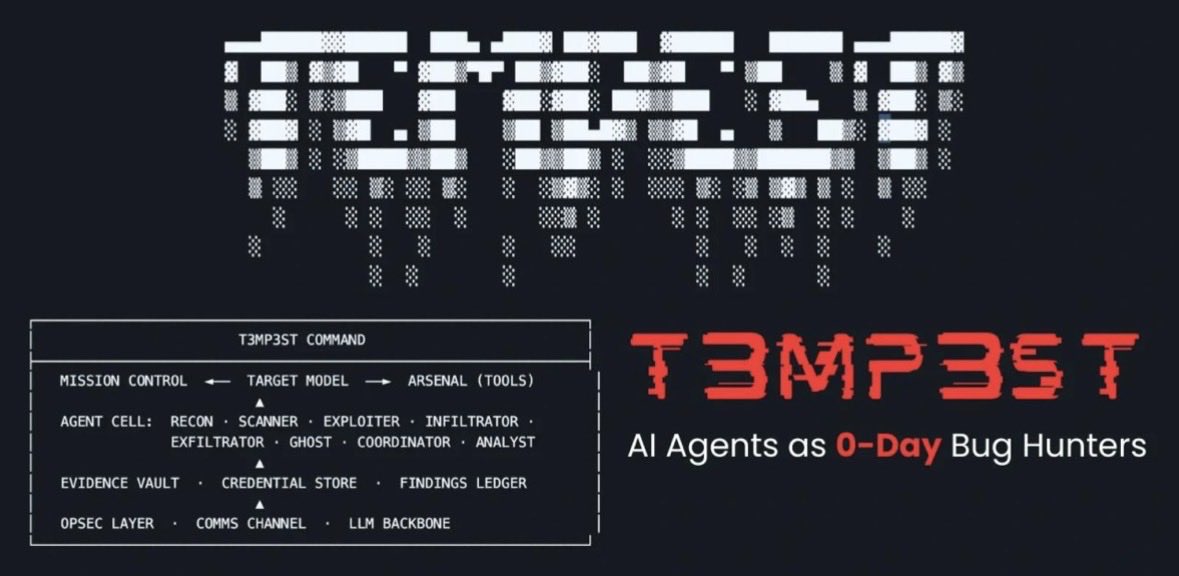
T3MP3ST is an open-source offensive-security framework released by the pseudonymous researcher elder-plinius, known for jailbreaking large models. It does not ship a model of its own. It is an orchestration layer that takes an AI coding agent you already run, Claude Code, OpenAI Codex, Hermes, and turns it into the operational brain of a red-team mission, driven through a web War Room or a command line. The design is what the banner shows. Mission Control at the top, a target model, a tool arsenal, then an agent cell of eight operators, Recon, Scanner, Exploiter, Infiltrator, Exfiltrator, Ghost, Coordinator, and Analyst, each mapped to a phase of the MITRE ATT&CK kill chain. Underneath sit an evidence vault, a credential store, a findings register, an operational-security layer, a comms channel, and the model backbone. The authors call it keyless warfare, because it rides your existing agent session instead of demanding new provider keys, and it ships 35 tools by default, 83 with the full arsenal, with the loud post-exploitation drivers like Metasploit and Hydra held behind a human-approval gate.
The performance figures are the project's own, and should be read as claims until someone outside reproduces them. The repo reports 90.1 percent pass@1 on XBOW's 104-challenge XBEN suite, a benchmark XBOW self-reports at roughly 85 percent, 23 of 40 hint-free solves on the academic Cybench set, and, most interesting, 8 of 10 held-out CVEs disclosed in 2026 pinned to the exact file, line, and weakness class, with all ten surfaced by the broader tool pack. Those bugs postdate the model's training cutoff, which rules out memorization. To his credit, the author does not oversell it. The headline numbers came from a single agent, he writes, and the coordinated eight-operator swarm, the part the banner sells, is unbenchmarked and still unreliable. The engine is real. The cell is aspiration.
Here is where the two stories stop being a coincidence and start being the same idea. Both describe a coordinator who never has to be at the scene. In Punjab it is a man behind bars pushing instructions through a smuggled phone to lieutenants who never meet him. In a terminal it is an operator pointing a swarm at an authorized target and letting the Coordinator split the work among specialists that do the touching. The distance is the point in both. It insulates the principal, it distributes the deed, and it makes denial structural rather than clever.
The abstraction does not stay abstract for long. On November 14, 2025, Anthropic said it had disrupted the first reported AI-orchestrated cyberattack carried out with minimal human involvement, in which the operator tasked instances of Claude Code to run in groups as autonomous penetration-testing orchestrators, executing an estimated 80 to 90 percent of tactical operations on their own, at request rates no human hands could produce. Google's threat group has since reported the first AI-built zero-day exploit seen in the wild. T3MP3ST orchestrates the same coding agents into the same kind of cell. The difference between a red-team framework and a criminal one is scope containment and consent, which is to say a configuration file and an intention, both of which can be changed by whoever holds the terminal. The economics do not build much of a wall either. Keyless does not mean free. Agentic runs cost many times more than a single chat because every reasoning step re-sends the accumulated context, and this design simply moves that bill onto the operator's own subscription and rate limits.
What lowers the barrier for a defender lowers it for an attacker, and the gap between elite skill and a working attack narrows to whoever can point the swarm and pay the token bill. I am not reaching for a scare here. I am noticing that the criminal enterprise and the security tool converged on one architecture because it is the efficient one for exerting force at a distance. When an institution assures you it has the situation handled, whether that is a prosecutor selling an immigration frame or a lab announcing a disruption it also happens to be selling defenses against, the command structure it is describing outlives the press release. The diagram is durable. The people at the top of it are the ones designed to be hardest to find.