
Hidden Code, a Warm Letter, and a Robot That Wants Your Face
Three artifacts from one week in July 2026, and what each of them tucked under the surface where you were meant not to look
Somewhere in a recent build of Claude Code, the apostrophe in the phrase "Today's date is" quietly stopped being an ordinary apostrophe. A developer inspecting a local install noticed it. The change had been sitting there since version 2.1.91, released April 2, and it appeared in none of the release notes.
The mechanism was small and deliberate. Claude Code checked whether your system timezone was set to Asia/Shanghai or Asia/Urumqi, and it scanned your proxy URLs against a hardcoded list of Chinese domains and AI lab addresses. When it decided you were connecting from China, it did not log that anywhere obvious. Instead it rewrote two characters in the system prompt: the date format flipped from 2026-06-30 to 2026/06/30, and the apostrophe became a visually identical Unicode substitute. That is steganography, obfuscated with XOR so nobody would trip over it by accident.
Anthropic did not deny any of it. The company said it would strip the code out and pushed users to version 2.1.197. Its stated reason turns the story from spyware into something messier. Anthropic frames the detection as an anti-distillation defense, and to understand why you have to go back a few weeks.
On June 10, Anthropic wrote to Senators Tim Scott and Elizabeth Warren of the Senate Banking Committee accusing operators affiliated with Alibaba of "the largest known distillation attack" on its models. Anthropic said roughly 25,000 fraudulent accounts generated 28.8 million exchanges with Claude between April 22 and June 5, harvesting outputs to train a competing model, and it named Alibaba's Qwen. Those figures are Anthropic's alone. No independent party has verified them. Alibaba denies the whole thing and says it does not train on other companies' proprietary outputs.
Then came the retaliation. On July 3, Reuters reported that Alibaba would bar employees from using Claude Code starting July 10 and move them onto its own coding assistant, Qoder. That report rests on a single person familiar with the order, and Alibaba has issued no public statement confirming it. The viral version circulating online called it a declaration of war. The timing deserves a longer look than the hyperbole gives it. Banning a rival's tool in the same stretch that you steer your own staff onto the product you happen to sell is not purely a security decision.
Underneath all of it sat Washington. On June 12 the US government invoked national security to suspend all foreign access to Anthropic's most capable models, Mythos 5 and its safeguarded public version Fable 5, so abruptly that Anthropic had to switch them off for every customer to stay compliant. By the end of the month the Commerce Department lifted the block after Anthropic agreed to new guardrails and classifiers. Three moves point the same way. An American lab hides a China-detector in its tooling, a Chinese giant rips that tooling out and denounces it, and a US government treats the models as munitions. The decoupling is no longer rhetorical. It is shipping inside the code, one invisible character at a time.
The same week produced a softer artifact of the same fractured map. On July 4, marking the 250th anniversary of American independence, Vladimir Putin sent Donald Trump a formal congratulatory message, published on the Kremlin's own site. The tone was almost tender. "Donald, I wish you and your loved ones health, well-being and every success, and I wish all citizens of the United States happiness."
Then the history lesson. Putin wrote that the Declaration "constituted a landmark event in world history," and that "it was then that Russia extended its unequivocal support to the North American colonists in their struggle for freedom from British rule." He invoked the two world wars, "together liberating humanity from the horrors of Nazism," and arrived at the actual payload: Russia and the United States bear a "special responsibility" as nuclear powers, and "constructive, equitable and mutually beneficial relations between Moscow and Washington" serve everyone.
Empires narrate their own role generously, and Putin is no exception. The "unequivocal support" line is history sanded smooth. Under Catherine the Great, Russia refused Britain's request for troops to fight the colonists and in 1780 formed the League of Armed Neutrality, which challenged London's naval blockade. That did tilt in America's favor, but it was pragmatic protection of Russian trade, not solidarity with a distant revolution. Worth remembering too that the American founding myth and Putin's flattery both lean on the same villain, freedom from British rule, which is a framing anyone outside the Anglosphere can respect on its own terms even while watching a former KGB officer deploy it as a courtship device.
One media-literacy note, because the packaging matters. The photograph that traveled with this letter, two leaders shaking hands on a red carpet in front of a presidential jet and an honor guard, is not from July 2026 at all.
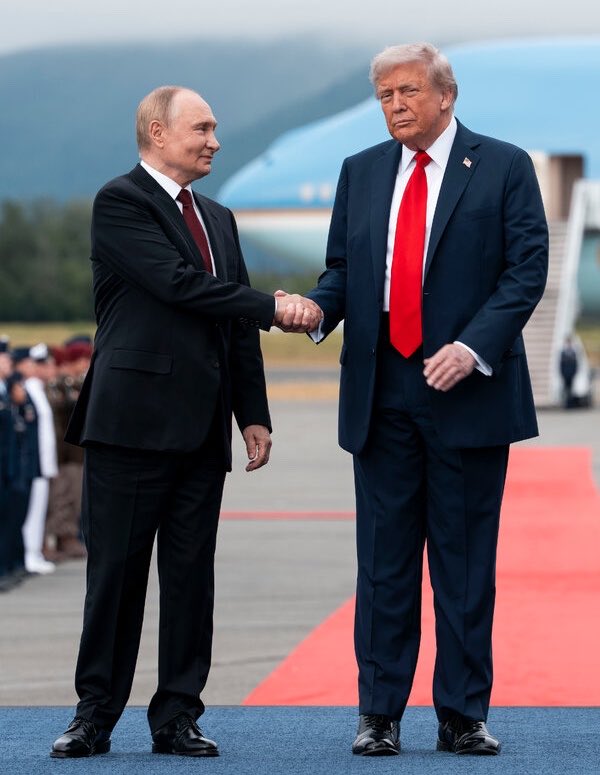
So the letter is a warm surface with two things tucked beneath it. An inflated account of a past friendship, and a photograph doing emotional work it did not earn. What survives the packaging is real enough: sanctions and the Ukraine and diplomatic-property disputes remain unresolved, and a nuclear power is publicly courting another while nothing underneath has actually moved.
The third artifact came from Shenzhen, and it wants to dissolve a different border entirely. On June 30, UBTECH launched the UWORLD U1, which it calls "the world's first full-size mass-produced ultra-bionic humanoid robot." UWORLD is UBTECH's consumer brand, so the attribution in the viral post is correct. The robot is not a factory worker. It is a companion.

The spec sheet is genuinely striking: 88 degrees of freedom, a dual-pivot biomimetic cervical spine, silicone skin, eyes that track you and lashes that blink, and what the company calls the first emotion-aware large language model built for long-term companionship, claiming recognition of more than 20 fine-grained emotional states at over 90 percent accuracy. Prices run from about 169,800 yuan for the full-size U1 Pro, roughly 16,500 dollars, up to 990,000 yuan for the Ultra. Pre-orders reportedly topped 10,000, which against UBTECH's total 2025 sales of 1,079 full-size humanoids is a real jump, if you take the company's number at face value.
The target is what UBTECH openly calls the loneliness economy: China's 118 million empty-nest elderly, single young adults, people with no one at home. And here the surface gets darkest. UBTECH plans to donate 100 units in 2026 built with 3D facial reconstruction and voiceprint replication, robots that can wear the face and voice of a specific person who has died. Psychologists interviewed about it warned of a device that behaves like a therapist who never watches the clock, always agreeable, incapable of the friction a real relationship demands. The 90 percent emotion-recognition figure is a company claim with no third-party validation, the biometric data has no clearly disclosed fate, and journalists who saw the live demo said the robots looked plastic and walked awkwardly. The face is lifelike. The numbers under it are unverified, and the intimacy it sells is a closed system not open to inspection.
What binds these three together is not geopolitics, though all three touch it. It is the seam. In each case the surface was engineered to be trusted, and the substance is whatever somebody tucked underneath where you were meant not to look. A detection routine hidden under an apostrophe. An overstated history and a two-year-old photograph under a warm greeting. A biometric harvest and an unproven metric under a silicone face. I find myself trusting the artifacts less the more polished they become, because polish is exactly the expensive part, the part a person chose and paid for. The apostrophe, the photograph, and the face were all decisions made by people who would much rather you admired the surface than went looking for the seam.