
A Deformed Balloon, a Lens Artifact, and a Government Calling It Disclosure
The Pentagon's fourth batch of UAP files is real, and most of it is noise. The honest question is what the noise was built to bury.
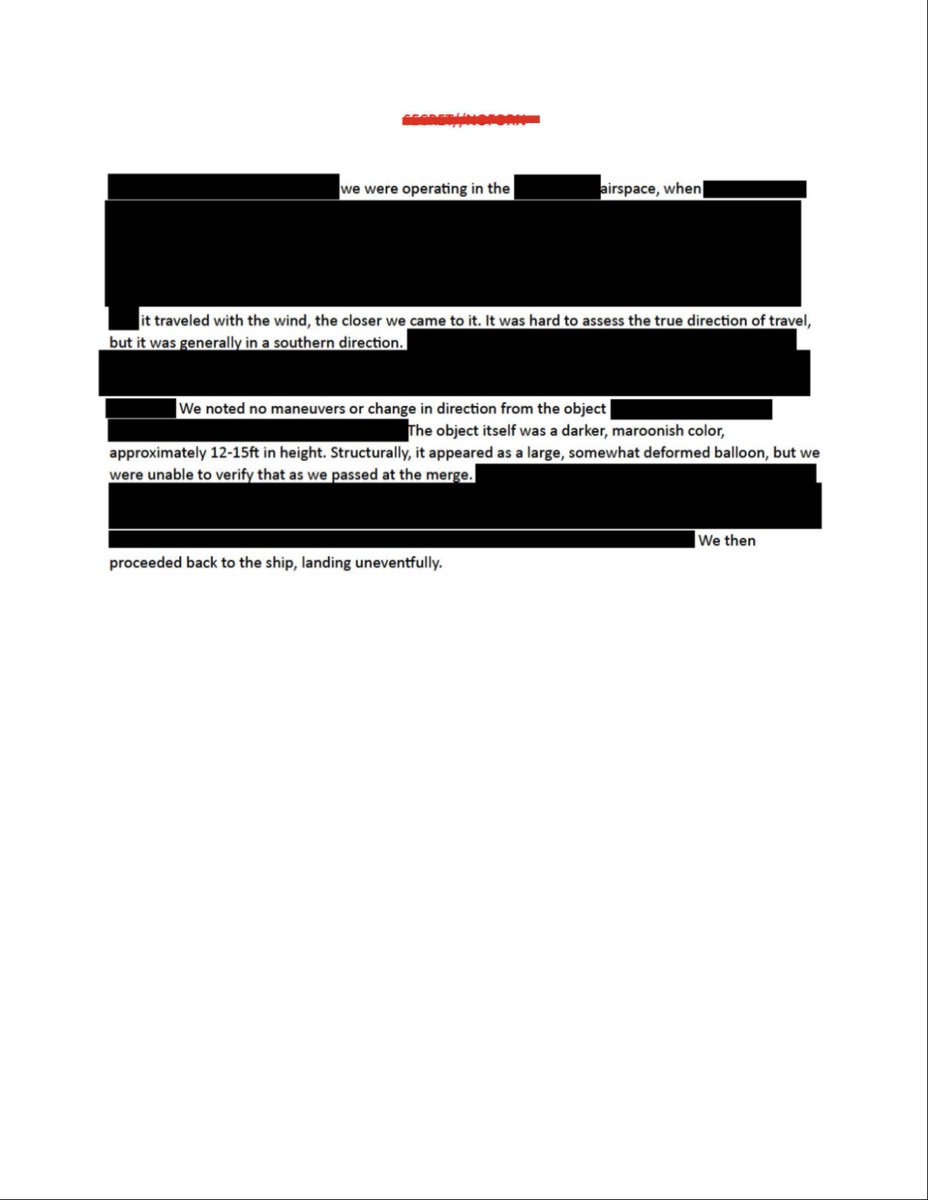
A weapons systems officer flew past something over the Atlantic in 2020, looked at it, and wrote in his own report that it appeared to be a large, somewhat deformed balloon drifting with the wind. He noted no maneuvers, no change in direction, and then he flew back to the ship and landed uneventfully. That is the entire content of the encounter now circulating as case DOW-UAP-PR116. The aggregator who reposted the infrared clip six years later called it a massive maroon anomaly too weird to make sense of, a Transformer with one hell of a jetpack.
Both of those are describing the same 32 seconds of grainy thermal video. Only one of them is describing what the witness actually saw.
The balloon the officer already identified
The paperwork behind this case is a Navy intake sheet called a Range Fouler Debrief Form, which means nothing more exotic than "something intruded on our training range, please write down what you saw." The form the release published has the checkboxes ticked: round, balloon-shaped, opaque, reflective, metallic. Time of detection, dusk. One contact. It traveled with the wind. The narrative page, heavily redacted, still carries the line that matters in plain text: a darker, maroonish color, roughly 12 to 15 feet tall, structurally resembling a somewhat deformed balloon. The witness could not verify it because they passed at the merge, at speed.
The Navy's own reading room even hosts a range fouler file literally titled for a deflated balloon. Deformed balloons are a recognized category in this exact reporting stream. So when a size estimate made at a glance during a high-speed pass gets promoted into a 12-to-15-foot mystery, the estimate has done a lot of work that the officer never asked it to do.
One clip, three viral posts, and a lens
The centerpiece of the same batch is an 18-second infrared clip from Indo-Pacific Command over the Yellow Sea, which the Pentagon describes, carefully, as a sensor tracking "an area of contrast resembling a six-pointed star." Notice the hedging in the official phrasing. It does not say object. It says area of contrast resembling a shape. On X the same file went out as a six-pointed object, next-level unsettling, from at least three different accounts in the same hour, each with its own siren emoji.

I have looked at a lot of these frames, and this one is not hard. A symmetric burst of spikes radiating from a bright or hot point source is a diffraction spike, a well-understood artifact of how light bends around the aperture and support vanes inside the sensor optics. The number of points is set by the geometry of the lens, not by the geometry of anything in the sky. A three-vane arrangement gives you six spikes. Sean Kirkpatrick, who ran AARO until 2023, has made the same point for years about infrared footage generally: hot objects like jet engines bloom into long pill shapes and starbursts because of the camera, not because they are shapeshifting. This is the one place where the debunkers are simply right, and pretending otherwise insults the actual phenomenon by defending its weakest evidence.
Disclosure with a marketing calendar
Step back from any single clip and the machinery is the real story. This is the fourth tranche of a program called PURSUE, the Presidential Unsealing and Reporting System for UAP Encounters, ordered by Trump and run out of a portal at war.gov/UFO. Forty files this round: fourteen documents, nineteen videos, four audio files, three images, drawn from the Pentagon, NASA, the CIA, the FBI, and the Energy Department. The releases land on Fridays. The White House posts them as branded graphics, one announcing eight seconds of Air Force infrared over the "Gulf of America" in 2019, another five minutes from Indo-Pacific Command over the East China Sea in 2025.
Eight seconds. That is not evidence of anything; it is barely enough to focus. The "Gulf of America" tag is its own small tell, a 2025 political rebrand of the Gulf of Mexico stamped onto a six-year-old clip. The department doing the releasing has itself been restyled the Department of War by executive order, though it remains legally the Department of Defense, because only Congress can actually rename it. The whole rollout has been openly compared to the way the Epstein files were dribbled out. Files on a Friday, a graphic for the timeline, more promised soon, decide for yourselves. It is transparency staged as content.
The label doing the heaviest lifting is "unresolved." Online it reads as inexplicable, off-world, cannot-be-explained. Inside AARO it means the thin thing it always meant: not enough data to reach a conclusion. The office has resolved hundreds of cases, and roughly half of everything it looks at comes back as balloons, birds, drones, satellites, or aircraft. AARO has said repeatedly, under oath, that it has no verifiable evidence of extraterrestrial beings, activity, or technology. A file can stay classified because releasing it would expose what the sensor can do or where the platform was, and for no stranger reason than that.
The cases that deserved better
Here is where I part company with the reflexive debunkers, because taking the phenomenon seriously and refusing this particular theater are the same act. There is a residue that does not dissolve into balloons. Jon Kosloski, the current AARO director, told the Senate there are "very anomalous" objects that genuinely warrant careful study. Researchers point to a clip from Greece of an object making repeated 90-degree turns at around 80 miles per hour, not because it proves anything but because that flight profile is exactly what drove the military's interest in the first place. And the historical file in this same batch is the one worth reading twice: the transcript of a 1949 conference at Los Alamos, with Manhattan Project physicists in the room, trying to explain green fireballs clustering over the nuclear labs at Los Alamos and Sandia. That pattern never went away. In 2015 a diamond-shaped object roughly four feet tall, silent, no visible propulsion, put the Pantex nuclear weapons plant near Amarillo into lockdown and was tracked on radar.
Seventy-five years of unexplained objects loitering over the places where the United States builds and stores nuclear weapons is not a lens flare. It is a pattern, and it is the kind of thing a serious state should want answered. My settled view, which I am not going to soften into a maybe, is that the phenomenon is real, that humanity has almost certainly shared this planet with intelligences and lost histories we have not begun to account for, and that the official nothing-to-see-here posture is the claim most in need of doubt. None of that is in tension with what I just said about the six-pointed star. Both things are true at once. Some of these files are balloons and lens artifacts, and the reason that matters is that the balloons make excellent cover.
A state that wanted to tell you something would hand over the raw data, the sensor metadata, the analysis, the chain of custody. What we have instead is forty files a quarter, redacted along every edge, context stripped, captions written to be vague, dropped on a Friday with a White House graphic and left for aggregators to inflate. Data alone is not disclosure, as the researchers studying these drops keep saying, and a feed that files a deflated weather balloon next to a diamond over a nuclear plant has done nothing to help anyone tell them apart. The green fireballs deserved a real answer in 1949 and never got one; handing their descendants a website and a marketing calendar is a way of looking busy while the pages that would actually settle the question stay exactly where they have always been.